AI Act and your chatbot: what does your customer service need to sort out?
In short
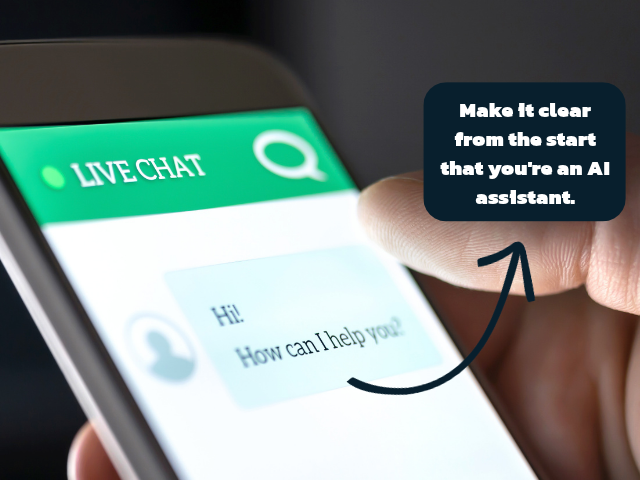
Your chatbot or voicebot has to say at first contact that it's AI and that its answers can be wrong. One sentence, in the conversation itself.
An AI-written email that an employee genuinely reviews and sends under their own name usually falls outside that rule. Emails that go out on their own don't.
Your team needs agreements and a short training on AI. Write down what you've done.
Can your chatbot pretend to be called Jerry and be a real colleague? Unfortunately not. Since August 2026, every customer has to know they're talking to a bot. That's in the AI Act (also called the EU AI Act or the AI regulation), and it applies to your chatbot as well as your voicebot. The good news: it's one sentence. It doesn't have to ruin your customer contact, as long as you place it smartly.
What can and can't you do? What about your AI emails? And how do you support your team? We'll explain it clearly.
What does the AI Act ask of your chatbot?
Every customer has to see or hear at first contact that they're talking to AI. You say that in the conversation itself, not in the small print of your terms and conditions.
There's one exception: when it's immediately obvious to everyone that it's AI. Don't count on it. A chatbot with a first name and a friendly little face? Not obvious. A voicebot with a natural-sounding voice? Not obvious either.
Here's how to keep it simple:
Give your bot its own name that can't pass for a human. Like Botty, Robby the Robot, Chatty, or a name that fits your brand, such as 'ParcelBot' if you run a webshop or 'Booking Assistant' if you run a hotel or restaurant.
Say it right away in the first sentence. For example: "Hi, I'm the AI assistant of [company]. Happy to help you get started."
Make sure your customers can easily chat with or call a human. That's not mandatory, but it gives your customers confidence.
Repeat it briefly when a conversation runs across several contact moments.
With a voicebot, say it out loud in the first few seconds.
No small print. Just one clear sentence.
Who has to take care of this? The law puts the obligation on whoever provides the system. If you build the bot yourself, that's you. If you use a platform, agree with your supplier who makes sure the notice is there. "I thought they were handling it" is not a good plan.
Does an AI email fall under the same rule?
No, not necessarily. The difference lies in who ultimately sends the email and is responsible for it.
If an employee uses AI to draft an email, they shouldn't simply forward the text without checking it. They need to read it through, adjust it where necessary and consciously send it under their own name. In that case there is human contact, and a separate AI disclosure is usually not needed.
If the AI sends the email fully autonomously, without human review, the customer does need to know the message was generated by AI. The same applies to other AI messages in your customer service that go out to customers without human involvement.
This is how the rules are currently interpreted. However, the exact application depends on the situation. If you're unsure how this applies to your organization, ask a lawyer for advice.
What does AI literacy mean for your customer service team?
Your team has to know what it's doing with AI. That obligation has applied since February 2025. Since July 2026 it's a bit more flexible: you don't have to prove that every employee reaches a certain level. You do have to make sure your team gets explanation and training.
In practice, it comes down to these four questions:
Which AI tools can the team use, and which not?
Which customer data can go into them, and which never?
Seven checks. All ticked off? Then you're in good shape.
Does every chatbot and voicebot say at first contact that it's AI?
Is your bot clearly recognisable as a bot, in name, picture and voice?
Does the customer know how to reach an employee?
Is there a notice in every message that AI sends on its own? If your bot says so at first contact, you don't have to repeat it in every message, but it's recommended for clarity towards your user.
Does an employee genuinely read AI drafts before they go out the door? This is really important, because as a company you're responsible for what your AI says or does.
Does your team have agreements and a short training on AI?
Do you know who takes care of the notice: you or your supplier?
This article is not legal advice. In doubt about your situation? Check with a lawyer.
Does my chatbot have to say it's a bot?
Yes. Every customer has to see or hear at first contact that they're talking to AI. That also applies to a voicebot.
Do I have to label AI emails?
Usually not, if an employee genuinely reads the email and sends it under their own name. Does your AI send emails on its own? Then add a notice. In doubt? Check with a lawyer.
Does my customer service team need training on AI?
You have to take measures to support your team's AI knowledge. A short training and one A4 page of agreements is a great start.
Want a free bag of cookies to feed the animals and make your stay at The Zoo even better?
Functional cookies
Always active
The technical storage or access is strictly necessary for the legitimate purpose of enabling the use of a specific service explicitly requested by the subscriber or user, or for the sole purpose of carrying out the transmission of a communication over an electronic communications network.
Preferences
The technical storage or access is necessary for the legitimate purpose of storing preferences that are not requested by the subscriber or user.
Statistics
The technical storage or access that is used exclusively for statistical purposes.The technical storage or access that is used exclusively for anonymous statistical purposes. Without a subpoena, voluntary compliance on the part of your Internet Service Provider, or additional records from a third party, information stored or retrieved for this purpose alone cannot usually be used to identify you.
Marketing
The technical storage or access is required to create user profiles to send advertising, or to track the user on a website or across several websites for similar marketing purposes.